
To be clear, the recipe is 165 years old, not the physical cake. I just want to start off by saying, lemons, and in fact all citrus, are very weird plants. Every citrus you can think of is some weird cross pollination of every other type of citrus, in a strange very intermingled family tree of sorts (1). A bit of a tangent, but in a pop-sci article, related to the previously cited article, the author describes citrus as “sexy” (2) which I find strange, but hey, whatever floats your boat, I guess? Anyway, back to the main topic: lemons, lemon cake, and historic Canadian foodways.
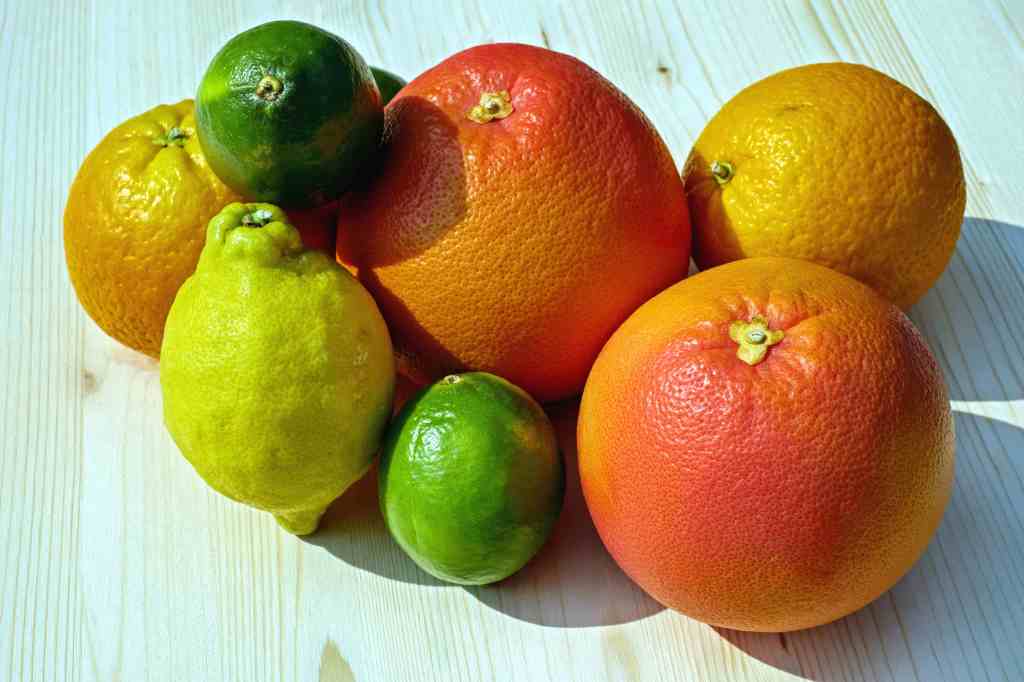
I am sorry to say that the lemon was first introduced to North America by none other than Christopher Columbus (sea voyage 15th C. – scurvy – vitamin C – citrus fruits) in the 1490’s, along with many other citrus species and hybrids (3). After introduction, these plants spread across the more tropical region of the Americas, eventually being bred to thrive in colder climates and moving up further north into Florida (3). However, for obvious reasons lemons have not been grown intensively in Canada. In the 1800’s (and also today) the vast majority of citrus fruits were imported from tropical regions, and thus in the past they would have been considered a luxury to most.
There is little reference to lemons (in their fresh state of being) in 19th century Ontario (as far as I have been able to tell), as they cannot be cultivated in the region, and thus would have had to be imported. Lemons were, therefore, a luxury item that would only appear occasionally in shops (R.D. Macpherson & Co., 1859), perhaps more frequently in larger cities such as Toronto. Lemon preserves (i.e. candied rinds, jellies, bottled juice) are found more frequently in catalogues (Eby, Blain Co. Ltd., 1895; R.D. MacPherson & Co., 1859), but would still have been a more expensive item, if not a luxury.
At the same time, the ubiquity of lemons in recipes from this time place them as fairly regular staples in at least middle to upper class cooking activities. Lemons and lemon-related products are referred to frequently throughout the book from which the recipe for today was taken. Lemon rind in pickling, lemon juice in beet molasses, both rind and juice in golden cake, as well as many other recipes.
I like to imagine that arriving to tea at a friends house and being greeted by a warm loaf of lemon cake would be something comparable to going to a little gourmet fair trade tea or coffee shop today – something wealthier people do all the time, but reserved to the occasional for the more middle-lower class. None the less, a great treat among women in villages and towns in southern Ontario.
The recipe is courtesy of “The female emigrant’s guide, and hints on Canadian housekeeping” (later retitled the Canadian Settler’s Guide) by Mrs. C.P. Traill (1854). This book was written as a sort of hand book and guide to immigrating to Canada (mostly Ontario) from the British Isles, and was aimed predominately to the middle to upper middle classes who might have a more difficult time acclimatizing to having to do things for themselves, especially hard labour. (4)
As a new settler and immigrant to Canada, women would have had to face a wide variety of new experiences and hardships, adjusting to this new way of life. To help the bourgeoisie adapt to their new environment, Mrs Traill wrote this book (4) detailing everything that a new immigrant could possibly need to know, from the prices of stoves, to furnishing a house, to local fruits and vegetables, to butchery, and on and on. Carefully detailing the domestic sphere and how it would differ in this new land, but assuring the new migrants that this land too, could be home.
Anyway, I have prattled on long enough at this point. On to the main attraction: my interpretation and execution of a 165 year old lemon cake recipe.
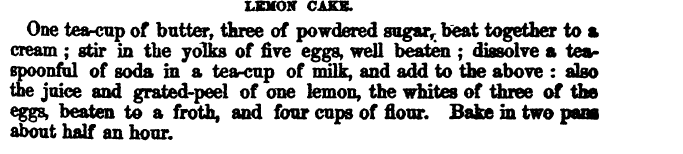
The first issue I had to confront was the issue of a modern oven versus the equivalent in 1854. No temperatures are given, for obvious reasons, so I went with a fairly common temperature for cakes and loaves, 350F (175C). Sure, sounds great so far.
The second problem encountered was the wording of the pans needed being an extremely vague “two cake pans”. Great, I thought, because all cake pans are the same size. I decided to make it in loaf pans, even though I was sure that wasn’t what the author had originally intended. I had to make something for a bake sale the next day, and figured a loaf splits into snack-sized pieces more easily than a more traditional cake does.
I would just alter the cooking time, right? Simple.
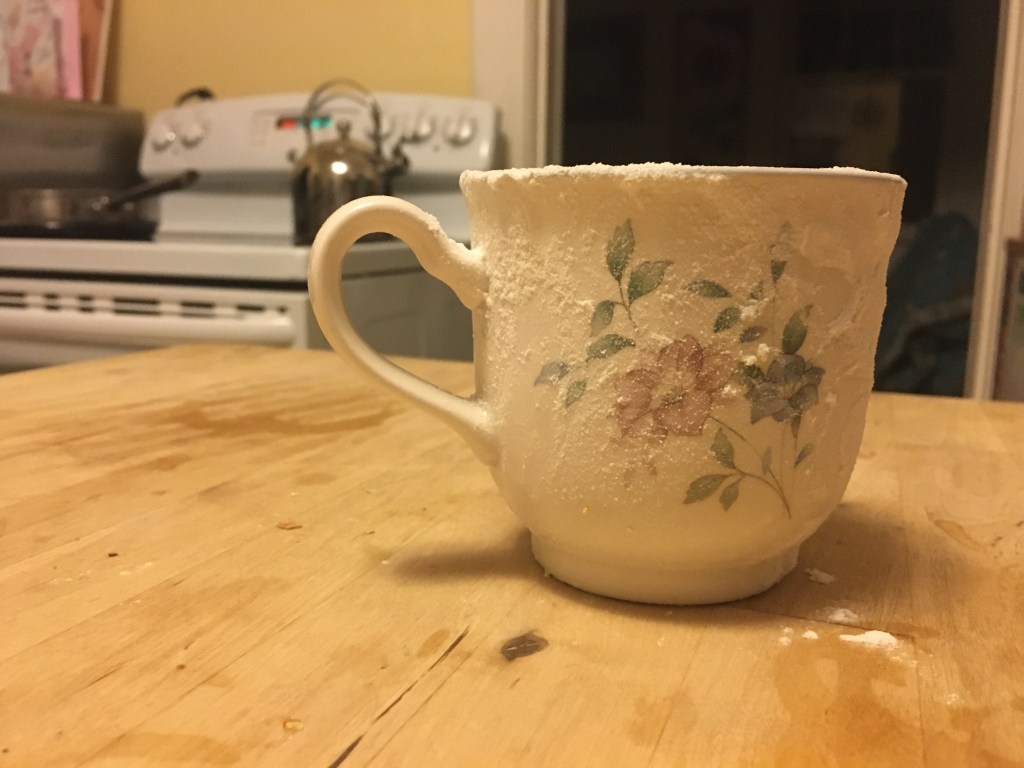
On to making the physical batter. I wanted to be “authentic” (whatever that means, but let’s not get into that too much here), or at least as close as I could get without investing any actual money into it. As such, I used a tea cup (as directed in the recipe) to measure, a wooden spoon, and hand whipped up my egg whites. This all was well and good until I got to the second instruction and realized I had but one tea cup (okay, well technically it is a coffee cup), and therefore had to wash and dry it individually for each ingredient.
I feel like I have been framing this in a negative light, but really, there were only minor hiccups, and it did turn out well, especially for a first attempt.
The crumb was fairly light, and moist. The crust, nice and crisp. A nice light and subtle lemon flavour brought the whole thing to life. All in all, a good experience. Other than the fact that it took somewhere around an hour to cook. But that’s my own fault for the whole “loaf pan” thing. I would also potentially try a slightly lower oven temperature, as I had a bit of an issue with the outside cooking much faster than the inside, necessitating my decreasing the oven temperature for the last fifteen to twenty minutes of cook-time.
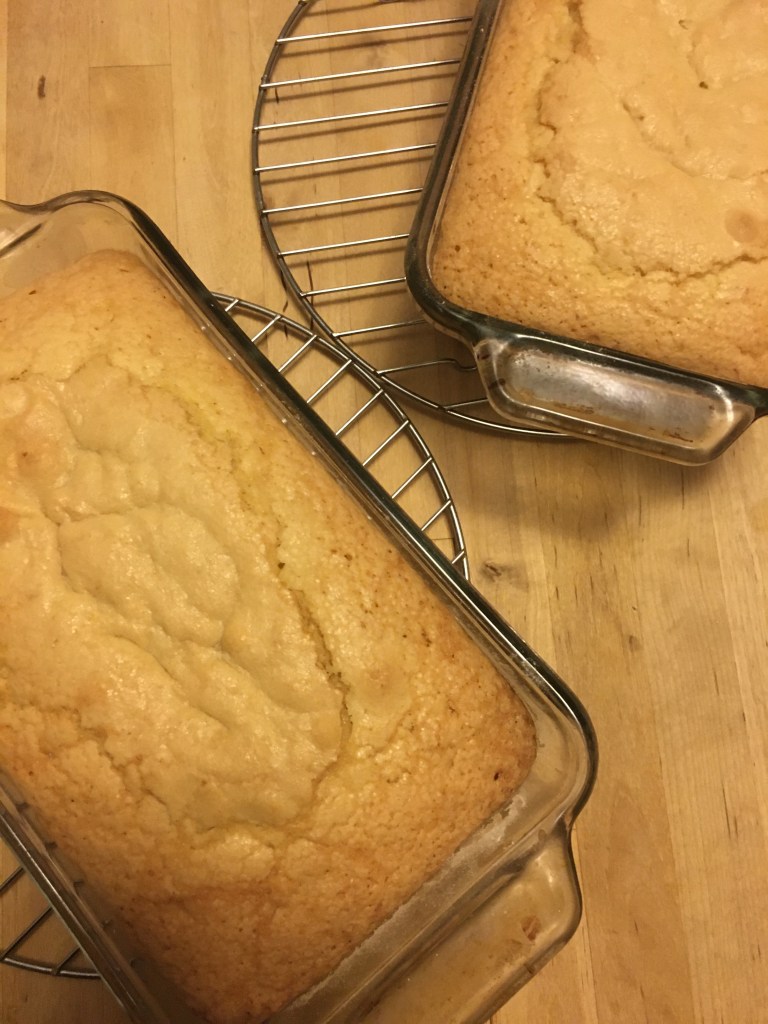
All in all, this was a lovely first historic cooking endeavour, resulting in a sweet, light cake and a slightly sore arm from mixing. Thank you for joining me on this lemon cake centred journey through nineteenth-century Canadian foodways.
If there is anything that you, reader, would like to hear about in the future, or that you think I should have addressed in this piece, please leave a comment below.
Citations:
(1) Wu, G., Terol, J., Ibanez, V. et al. Genomics of the origin and evolution of Citrus. Nature 554, 311–316 (2018) doi:10.1038/nature25447
(2) Serrano, M. (2017, January 11). The Citrus Family Tree. Retrieved November 22, 2019, from https://www.nationalgeographic.com/magazine/2017/02/explore-food-citrus-genetics/#close.
(3) Masterson, J. (2007, December 1). Indian River Lagoon Species Inventory. Retrieved November 22, 2019, from https://naturalhistory2.si.edu/smsfp/irlspec/Citrus_spp.htm.
(4) Traill, C. P. S. (1854). The female emigrants guide, and hints on Canadian housekeeping. Toronto, C.W.: Maclear. http://www.canadiana.ca/view/oocihm.41417/1?r=0&s=1
Photos: 1- copyright free citrus medley; 2- screenshot from book; 3-4 Photo credit to K. McCartney, 2019 (titles as shown)
I acknowledge that the land on which I live, work, and study is the traditional land of the Haudenosaunee and Anishinaabe peoples.
Postscript:
I thought some people here might be interested in this, so I decided to add a short piece on some more zooarchaeology related things I have been up to.
I spent all weekend last week preparing fish reference skeletons: an unknown species of salmon’s head (potentially Salmo salar); an offshore rockfish (Pontinus kuhlii); a Mediterranean parrotfish (Sparisoma cretense); and a walleye (Sander vitreus) – the walleye was also dinner pre-preparation, as a fun fact.
My parrotfish reference is named Guinevere, and I love her (this species has clear colour differentiation between biological sexes, although they are one of those fish species in which some change sex because fish are weirdos)
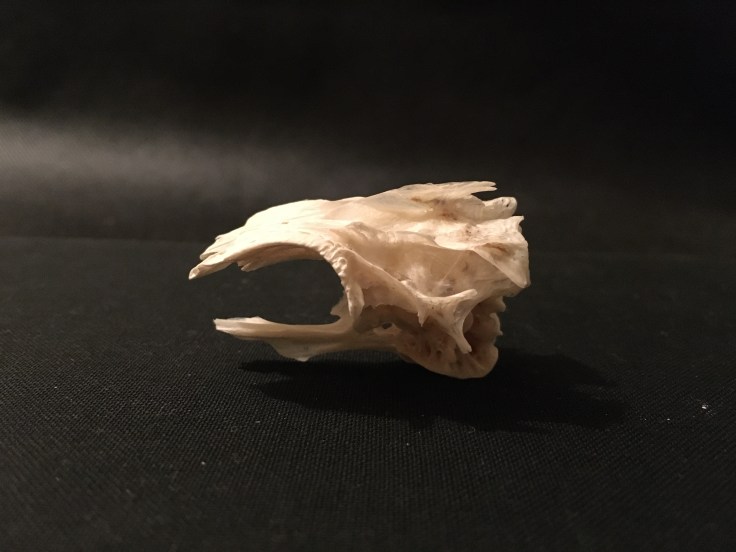
This topic is to be expanded on in an upcoming short post!
 Bones and Biscuits
Leave a comment